Are Bifacial Solar Panels Worth It? When the Rear Side Actually Helps
Bifacial solar panels can collect light on both the front and rear surfaces, but that does not mean every bifacial installation automatically produces a meaningful bonus. Their value depends heavily on mounting height, what sits behind the panel, spacing, shade, and how much reflected light can reach the rear cells. For buyers comparing high-output panels, the useful question is not simply whether bifacial technology is better. It is whether your installation gives the rear side enough light to matter. As an Amazon Associate, we earn from qualifying purchases.
Quick Answer
Bifacial solar panels are most compelling when the rear of the module is exposed to reflected light, such as an elevated ground mount, canopy, pergola, or other open structure over a reasonably reflective surface. They are less compelling when mounted flush against a dark roof where little light reaches the rear. Compare the entire installation, not just the bifacial label.
Recommended Products
Based on listed specifications. Prices and availability change — check Amazon for current details.
Disclosure: As an Amazon Associate, we earn from qualifying purchases. This helps support our site at no extra cost to you.
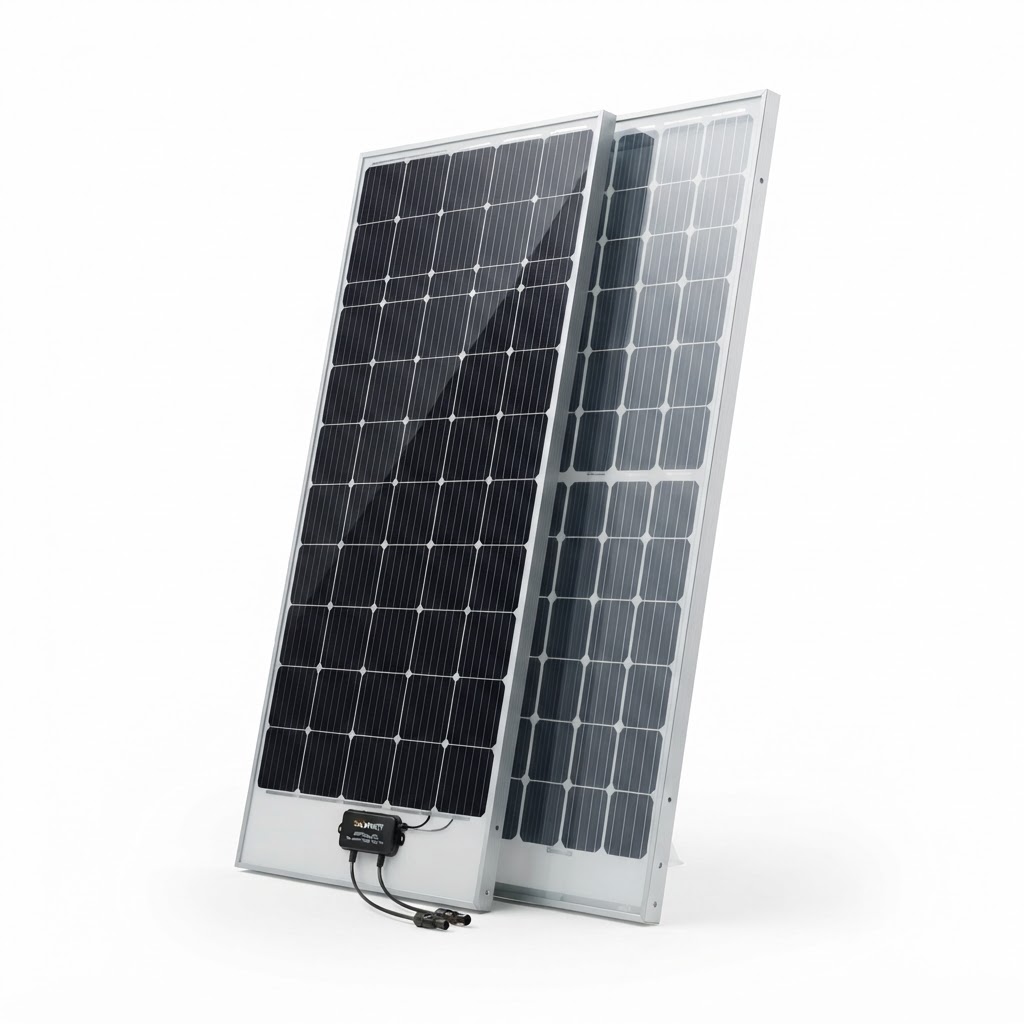
WATTS
455W
EFF.
22.5%
TYPE
Rigid
CELL
TOPCon
Canadian Solar 455W BiHiKu7 Bifacial Panel
by Canadian Solar
TOPCon bifacial cells with up to 30% rear-side gain in optimal albedo conditions
Who this is for
- Bifacial design captures rear-side light
- TOPCon technology for high efficiency
- Up to 30% bonus energy from albedo
Avoid if
You're flush-mounting on a dark roof or need portability
How a bifacial solar panel works
A conventional monofacial module is designed primarily to convert light striking the front surface. A bifacial module uses a construction that can also convert light reaching the rear. That rear illumination usually comes from sunlight reflected by the ground, roof, or another nearby surface. The amount of additional energy is therefore site-dependent. A bright surface with open rear exposure can create a very different result from a dark surface a few inches behind the module. This is why a headline rear-side gain should never be treated as a guaranteed production number. Module technology also varies. Some bifacial products use TOPCon or other modern cell architectures, but the cell technology and the bifacial construction are separate characteristics. When comparing products, look at the front-side electrical specifications first, then evaluate whether your mounting geometry can make the rear side useful.
Where bifacial panels make the most sense
Open ground mounts are a natural fit because the array can be elevated and spaced so reflected light reaches the back. Solar canopies and pergolas can also work well because both sides of the module remain exposed. Light-colored gravel, concrete, certain roofing surfaces, or snow can reflect more light than dark soil or asphalt, although actual performance varies with conditions. Row spacing matters too. If adjacent panels or structural members shade the rear surface, the bifacial advantage can shrink. For an off-grid buyer, bifacial may be attractive when the mounting structure is already elevated and the extra rear exposure comes without a complicated redesign. For a flush-mounted rooftop buyer, paying extra solely for bifacial capability may be harder to justify if the back of the panel sees little usable light.
When bifacial is probably not the deciding factor
If the panel will sit nearly flush against an opaque, dark roof, evaluate it primarily as a front-producing solar module. The same applies when a rack, wall, or other obstruction blocks much of the rear surface. In those situations, front-side efficiency, rated wattage, dimensions, warranty terms, electrical compatibility, and cost per usable watt may be more important than the bifacial label. Portable applications require another check: some foldable or portable bifacial products can expose the rear effectively, while others may spend much of their time positioned in a way that limits reflected light. The lesson is simple: buy for the installation you actually have. A technology feature only creates value when the system lets you use it.
A bifacial product to compare
The site’s current direct-linked catalog includes the Canadian Solar 455W BiHiKu7 Bifacial Panel, listed as a rigid TOPCon bifacial module. Its catalog data makes it relevant to shoppers considering larger ground-mounted or elevated arrays. Use the product card to inspect the current Amazon listing and confirm the exact model, electrical specifications, dimensions, warranty information, and mounting requirements. Any efficiency or rear-side performance figures should be treated as listed manufacturer specifications and not as guaranteed site output. Prices and availability change, so check current Amazon details before purchasing.
Efficiency, wattage, and bifacial gain are different numbers
These terms are easy to blend together. Rated wattage describes the module’s power under standardized test conditions. Efficiency describes how effectively the module converts incident solar energy over its area under specified conditions. Bifacial gain refers to additional energy that may be captured from rear-side illumination relative to a comparable front-only situation. A high-efficiency panel is useful when area is limited, while a high-wattage panel can simply be physically larger. Bifacial capability adds another variable because installation geometry affects rear production. When comparing two modules, do not assume the one with the most impressive single number will deliver the most annual energy on your site. Compare dimensions, front-side rating, temperature behavior, shading, mounting, inverter or controller limits, and expected rear exposure together.
A practical buying checklist
Before choosing bifacial, answer six questions: Is the rear surface exposed? Is there space beneath or behind the panel? Is the surrounding surface reasonably reflective? Will the mounting structure create rear shade? Does the module’s voltage and current fit your inverter or charge controller? Does the physical size fit the planned array? If the first four answers are mostly no, bifacial capability may add little to the installation. If they are yes, it deserves serious consideration. Also compare warranty terms and structural requirements because large rigid modules can require substantial mounting hardware. Manufacturer specifications may change, so verify the current datasheet and product listing before designing around a specific model.
Frequently Asked Questions
Do bifacial solar panels work on a roof?
Yes, but rear-side benefit depends on mounting clearance, roof reflectivity, spacing, and obstructions. A flush mount over a dark roof generally provides less opportunity for rear-side light than an elevated installation.
Are bifacial solar panels more efficient?
Bifacial capability and front-side efficiency are different characteristics. Some bifacial panels also use high-efficiency cell technologies, but rear-side energy gain depends on the installation.
What surface is best under bifacial solar panels?
Surfaces that reflect more light can improve rear illumination, but performance varies by material, geometry, season, cleanliness, and mounting height. Use site-specific modeling for important installations.
Are bifacial panels good for ground mounts?
Ground mounts can be a strong use case because panels can be elevated and spaced to expose the rear surface to reflected light.
Should I buy bifacial panels for an RV?
Only if the mounting arrangement can expose the rear surface. A panel mounted directly against an RV roof may not make meaningful use of its rear side.
Disclosure: As an Amazon Associate, we earn from qualifying purchases. This helps support our site at no extra cost to you.
Related Guides
Best Bifacial Solar Panels (2026) — Dual-Sided Picks
Best bifacial solar panels for ground mounts, pergolas, and reflective surfaces. How bifacial panels work and which models deliver the most extra yield.
Bifacial vs Monocrystalline Solar Panels — What's the Difference?
Bifacial vs monocrystalline solar panels compared. Understand the difference, when each is better, and which panel type is right for your installation.
Bifacial Solar Panel Market: Growth, Trends & Consumer Impact (2026)
Bifacial solar panel market overview for 2026. Market growth, technology trends, price changes, and what it means for buyers considering bifacial panels.
Most Efficient Solar Panels Commercially Available (2026)
The most efficient solar panels commercially available in 2026. IBC, HJT, TOPCon, and PERC cell efficiency compared. Real-world efficiency rankings.