Best Flexible Solar Panels for RV Roofs: What to Look For
Flexible solar panels solve a specific RV problem: getting useful solar generation onto roofs where weight, curvature, clearance, or drilling make conventional rigid modules awkward. They are not automatically better than rigid panels, but the right flexible panel can be an excellent fit for teardrops, vans, fiberglass roofs, boats, and other installations where a low-profile module matters. This guide explains the tradeoffs that actually affect an RV installation and points to a direct-linked product option already cataloged on this site. As an Amazon Associate, we earn from qualifying purchases.
Quick Answer
For an RV roof that is curved or highly weight-sensitive, a quality monocrystalline flexible panel can be a practical choice. Prioritize a panel that fits the available roof area, uses connectors compatible with your charge controller, has appropriate weather protection, and can be installed with enough attention to heat management. If your roof is flat and weight is not a concern, a rigid panel may provide a more durable long-term installation.
Recommended Products
Based on listed specifications. Prices and availability change — check Amazon for current details.
Disclosure: As an Amazon Associate, we earn from qualifying purchases. This helps support our site at no extra cost to you.
WATTS
175W
EFF.
22.4%
TYPE
Flexible
CELL
Monocrystalline
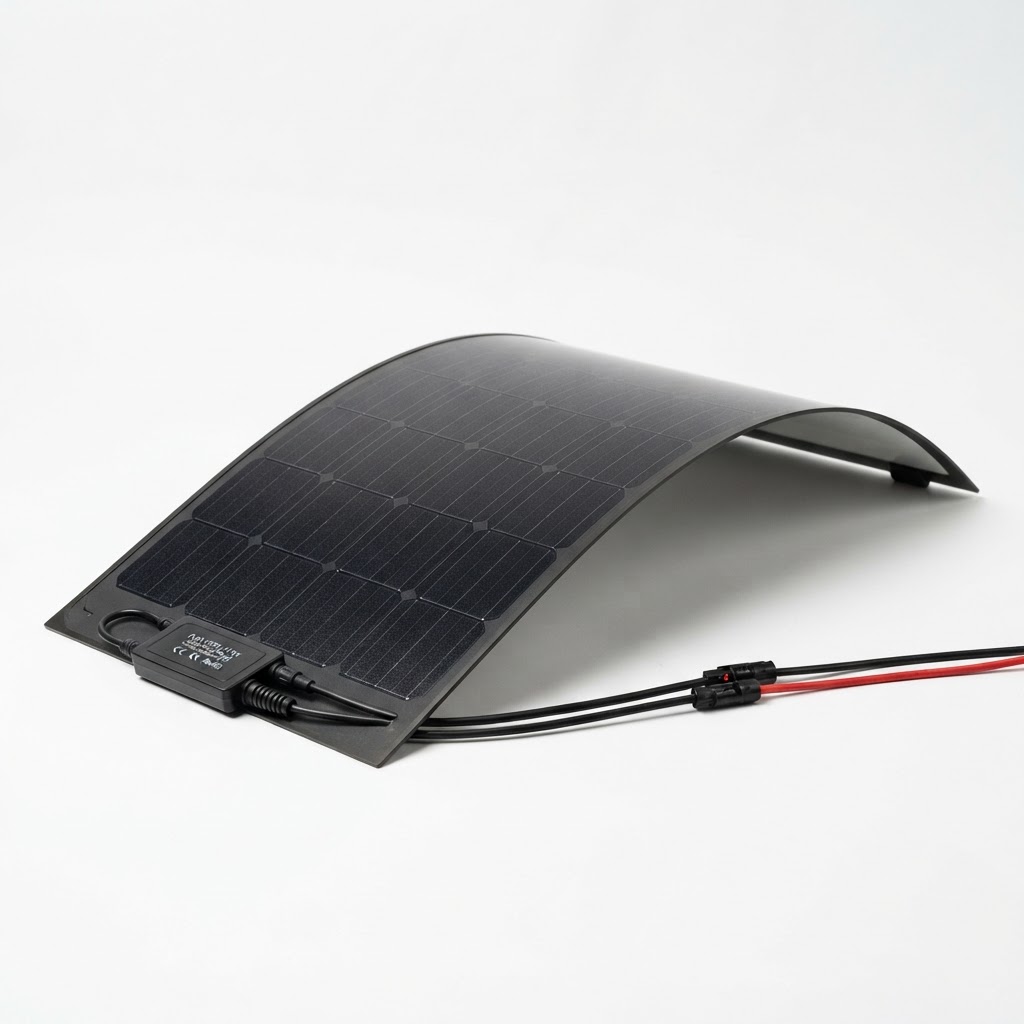
Renogy 175W Flexible Solar Panel
by Renogy
Uses advanced monocrystalline cells in a flexible laminate — top of class for flex panels
Who this is for
- Ultra-lightweight at only 6.2 lbs
- Bends up to 248° for curved surfaces
- Strong efficiency for a flexible panel
Avoid if
You want maximum long-term durability or need tilt-adjustable mounting
Why flexible solar panels work well on some RV roofs
Flexible modules are thin, light, and easier to conform to mildly curved surfaces than framed glass panels. That makes them attractive on vans, fiberglass trailers, pop-up campers, and marine-style roofs where a bulky rack may be undesirable. Low profile also reduces visual bulk and can simplify clearance around vents or rooftop accessories. The tradeoff is thermal management and long-term durability. A panel mounted directly against a hot roof may operate warmer than a ventilated rigid panel, and heat can reduce real-world output. Before buying, map the usable roof area, identify shade from air conditioners and vents, and decide how wiring will reach the charge controller. The best flexible solar panel is not simply the one with the highest wattage. It is the one that physically fits the roof, matches the electrical system, and can be installed without creating a heat, sealing, or cable-routing problem.
Flexible versus rigid panels for an RV
Rigid panels remain the default choice for many permanent RV installations because their frames create an air gap when rack-mounted, the glass surface is durable, and replacements are straightforward. Flexible panels trade some of that structural protection for low weight and a very thin profile. That can be worthwhile when roof load matters or when the mounting surface is not flat. Think about the installation rather than choosing by category alone. A flat fifth-wheel roof with plenty of capacity may benefit more from rigid modules. A curved van roof or lightweight trailer may favor flexible modules. Also consider serviceability. Adhesive-mounted panels can be harder to remove than bolted rack-mounted modules. If you expect to upgrade the system later, plan attachment and cable routing so the installation does not become permanent in all the wrong ways.
Specs that matter before you buy
Start with dimensions and wattage, then verify operating voltage, connector type, weather rating, weight, and the manufacturer’s installation guidance. Claimed efficiency is useful when roof area is scarce because a more efficient module can produce more rated power from a given area, but efficiency alone does not determine daily energy harvest. Shade, orientation, temperature, wiring losses, and charge-controller behavior all matter. Match the array voltage and current to the limits of your controller or portable power station. For a traditional RV battery system, confirm whether the controller is PWM or MPPT and stay within its input limits. For a power station, check the station’s solar input voltage, current, and connector requirements before ordering adapters. Manufacturer specifications may change, so verify current electrical details before purchase.
A direct-linked flexible option to compare
The product catalog currently includes the Renogy 175W Flexible Solar Panel as a flexible monocrystalline option. Its listed specifications make it relevant for curved RV roofs and other installations where a low-weight panel is useful. Treat any listed wattage, efficiency, dimensions, weather rating, and compatibility information as manufacturer specifications rather than independent test results. Use the product card on this page to review the current Amazon listing and confirm that the model, connector arrangement, dimensions, and installation requirements match your RV. Prices and availability change, so check current details on Amazon before purchasing.
Installation mistakes that can erase the advantage
The most common planning error is treating a flexible panel as a peel-and-stick appliance. Roof material, adhesive compatibility, cable entry, drainage, heat, and future removal all deserve attention. Avoid creating pockets where water can collect and do not cover manufacturer-specified ventilation or mounting areas. Shade is another major issue: a roof vent or air-conditioner shadow can cut output during useful sun hours. Lay out the array before drilling or bonding anything. Finally, protect wiring from abrasion and movement and use properly rated overcurrent protection where your system design requires it. If you are unsure about the electrical side of an RV solar installation, use a qualified installer rather than improvising around battery and charging circuits.
How to choose the right wattage for your RV
Work backward from energy use. Estimate daily watt-hours for lights, fans, refrigeration, electronics, pumps, and inverter loads, then compare that with realistic solar production for where and when you travel. A panel’s nameplate wattage is a laboratory rating, not a promise of all-day output. Weather, season, panel angle, temperature, and shade change production. Flexible panels can be especially sensitive to roof orientation because they are often mounted flat and cannot easily be tilted. If your energy needs are substantial, consider whether multiple modules will fit and whether your controller can accept the combined array. Our solar calculator can help turn daily energy use into a starting panel-size estimate.
Frequently Asked Questions
Are flexible solar panels good for RVs?
They can be very good when low weight, low profile, or a mildly curved mounting surface matters. For a flat roof where durability and ventilation are priorities, rigid panels may still be the better choice.
Can flexible solar panels be mounted directly to an RV roof?
Some products support low-profile or adhesive-style installations, but mounting requirements vary. Follow the panel and RV-roof manufacturer guidance and account for heat, sealing, drainage, and future removal.
Do flexible solar panels produce less power than rigid panels?
Not necessarily by nameplate rating. Real-world output depends on cell technology, temperature, shade, orientation, wiring, and system design. Direct roof mounting can increase operating temperature, which can affect output.
How many flexible panels does an RV need?
That depends on daily energy use, available roof area, battery capacity, travel season, and solar conditions. Calculate daily watt-hours first, then size the array and controller together.
What should I verify before ordering an RV solar panel?
Verify dimensions, wattage, operating voltage, current, connectors, weight, weather rating, mounting instructions, controller limits, and whether the panel physically fits around rooftop obstacles.
Disclosure: As an Amazon Associate, we earn from qualifying purchases. This helps support our site at no extra cost to you.
Related Guides
Flexible vs Rigid Solar Panels — Which Should You Buy?
Flexible vs rigid solar panels compared. Efficiency, durability, cost, and best use cases. Which panel type is right for your RV, van, or boat?
Are Flexible Solar Panels Worth It? (Honest 2026 Breakdown)
Are flexible solar panels worth the money? Honest breakdown of lifespan, efficiency, cost, and when flexible panels make sense vs when rigid is better.